

Direct-to-shape (DTS) printing is established in selected industrial applications, but extending it to complex geometries and demanding production environments requires more than reliable ink deposition. The IPI 2026 programme explores how robotics, printhead control, data preparation, motion measurement, surface treatment and curing contribute to the process. Its focus is not simply printing on curved objects, but integrating digital printing into industrial manufacturing.
THE HEADLINE ACT: DIGITAL PAINTING FOR AUTOMOTIVE CUSTOMISATION
One of the programme’s keynotes brings together Axalta, Dürr Systems and Xaar to discuss a robotic vehicle-painting system. Since 2024, the partners have worked on combining digital print technology, advanced coatings and automated application across complex three-dimensional car surfaces.
The presentation will explore customised graphics and two-tone finishes, alongside the technical challenges of bringing digital paint personalisation into OEM production environments. Images and videos will illustrate the robotic system and its application capabilities.
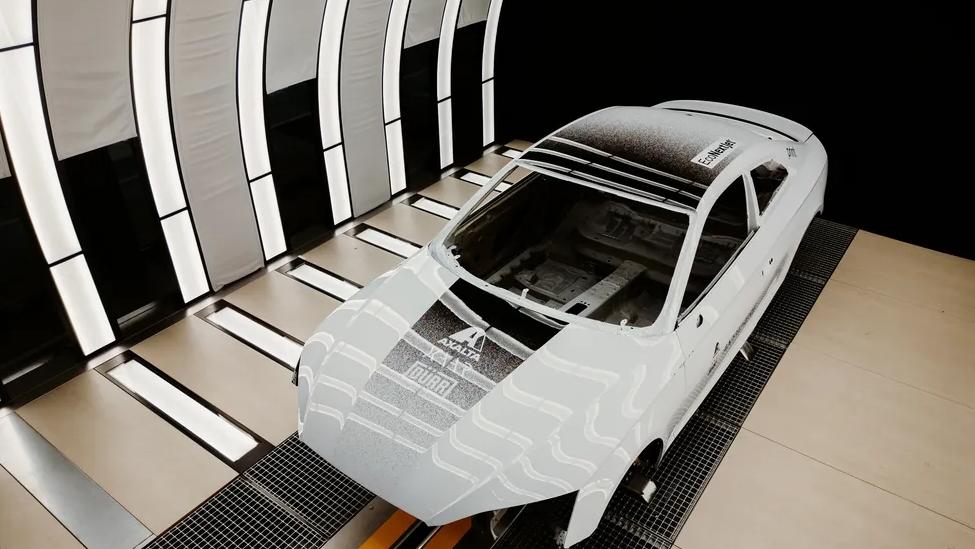 Image source: Dürr Systems AG
The significance lies in integrating digital coating technology with robotics and automotive manufacturing requirements. The coating, print architecture, robot motion and application process must work together to achieve the required finish. The collaboration also highlights the importance of aligned incentives and regular technical engagement when integrating new technology into established manufacturing environments. The keynote will address both the opportunities and the challenges that remain on the path towards automotive production.
AROUND THE PROGRAMME: ADDRESSING THE PROCESS CHAIN
Plasmatreat: Preparing the Surface
Surface condition is critical when printing on moulded, extruded and cast components. Low surface energy, contamination and release agents can affect wetting and adhesion, even when droplets are deposited accurately.
Plasmatreat’s presentation examines the integration of Openair-Plasma® into DTS processes. Depending on the substrate and treatment conditions, plasma can remove organic contamination and modify surface chemistry, improving wettability and potentially adhesion. The process can be integrated into production lines and applied selectively or across larger surfaces
An important consideration is the interval between treatment and printing. Surface activation may change over time, while handling can introduce contamination. Process integration must therefore account for the condition of the surface when ink is deposited. The presentation addresses plasma control, process integration and nanocoating technologies in the context of reliable printing on complex objects.
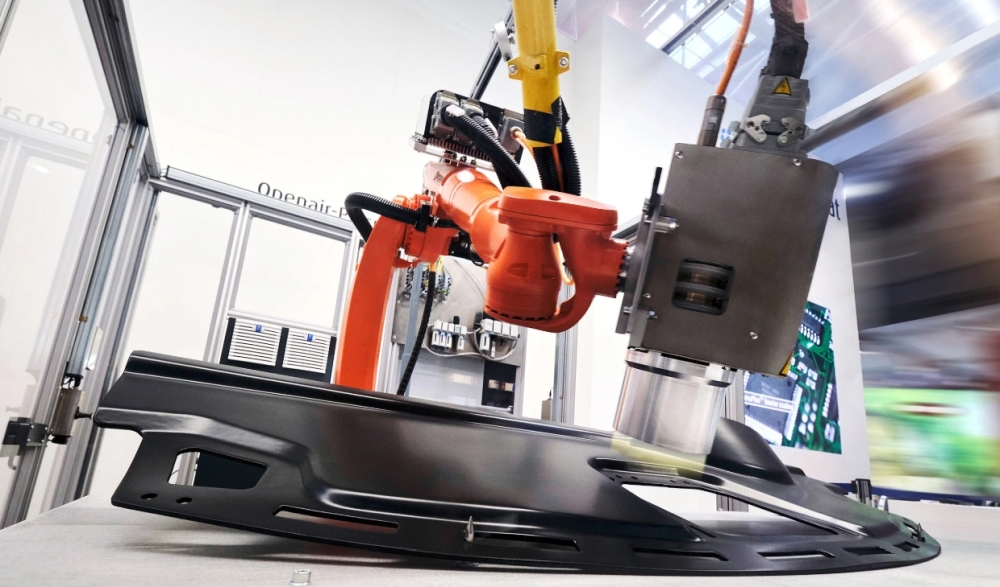 Image source: Plasmatreat GmbH
Polytype: Translating Artwork into Three-Dimensional Print Data
Printing on complex geometries requires two-dimensional artwork to be transformed into data corresponding to the object’s surface and the printing system's motion.
Polytype's software combines surface geometry with printhead trajectories to calculate the required artwork transformation. Algorithms divide printing areas across multiple printheads and manage their stitching, accounting for physical printing conditions such as density variations and droplet time of flight.
The presentation follows the software’s development from a prototype shown at IPI 2023 towards an industrialised solution. Its modular architecture separates geometric processing from the machine concept, allowing adaptation to different axis configurations, printhead types, colour setups and single- or multi-pass strategies.
The aim is to reduce the complexity of preparing print data for different machine configurations. Its practical value depends on how effectively it accommodates specific geometries, printing conditions and machine requirements.
RISO Technologies: Controlling Drop Formation at Variable Gaps
In DTS printing, the distance between printhead and substrate can change across an uneven surface, affecting droplet formation and placement.
RISO Technologies addresses this challenge through per-nozzle drive waveform control for high-gap DTS printing. A specialised driver IC allows individual nozzle waveforms to be controlled independently, with the aim of optimising dot formation according to the local printhead-to-substrate gap.
A single waveform setting may not produce the same drop behaviour under different stand-off conditions. Tailoring nozzle actuation to the local gap offers a way to address this variation.
The significance lies in applying nozzle-specific waveform control to high-gap printing. Its practical benefits depend on the achievable operating range and resulting improvements in dot formation and image quality. Printhead control remains one part of the wider challenge, alongside geometry, motion, data preparation and ink characteristics.
Epson: Complex Shapes and Functional Materials
Epson's contribution covers DTS printing and functional-material deposition. The presentation focuses on compact printheads designed to jet specialised fluids, extending inkjet applications beyond conventional colour printing.
Industrial applications include electronics, displays, photovoltaics, and biological and medical technologies. The required printhead characteristics depend on the fluid, the intended function of the deposited material and the manufacturing process.
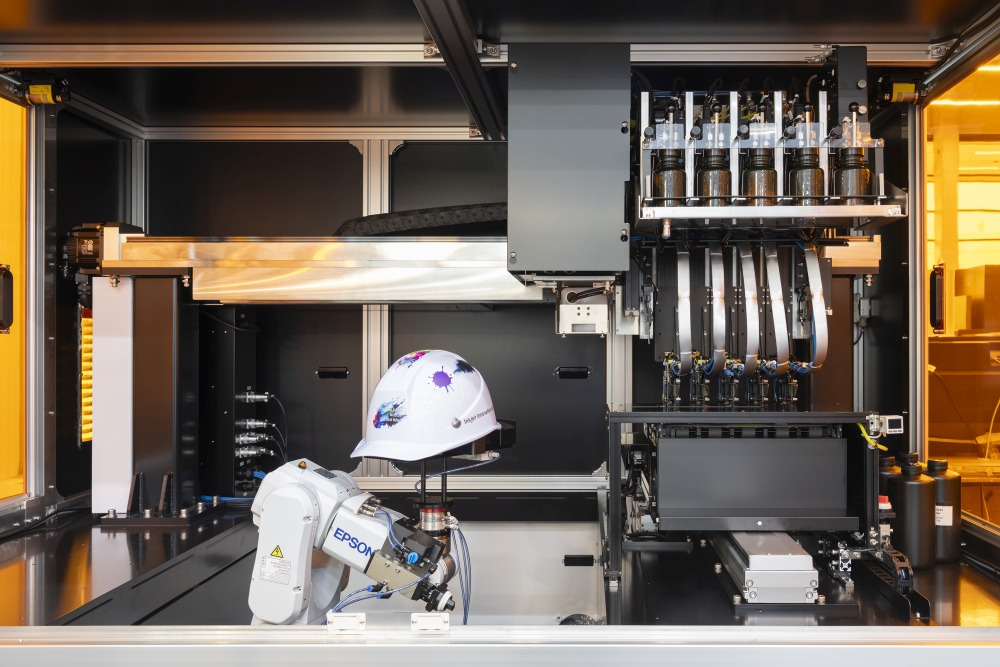 Image source: Epson Deutschland GmbH
The presentation also addresses printing on uneven, curved, textured and other complex surfaces. These applications place additional demands on printhead integration and droplet placement, while functional deposition introduces requirements related to material behaviour and process conditions.
The common principle is digitally controlled material deposition. For DTS, the focus is printing on complex geometries; for functional manufacturing, it is placing materials that serve a specific purpose beyond visual decoration.
IST INTECH: LED Curing on Three-Dimensional Objects
In UV-curable DTS applications, the curing system must deliver appropriate exposure across surfaces whose distance and orientation relative to the light source vary.
IST INTECH’s presentation, Mind the Gap: LED Curing Integration for Direct-to-Object Inkjet Printing, examines how optics, working distance, irradiance and exposure dose influence curing on cylindrical and irregular objects.
Variations in distance and angle can affect surface cure, adhesion, gloss consistency and durability. Object shape and movement also influence exposure across the surface.
The presentation considers beam angle, focal distance, exposure time, rotation and transport speeds, alongside thermal management and shadowing at production speeds. Application examples will illustrate how optical design and curing parameters can be optimised for particular conditions.
The central issue is integration: curing performance must be assessed in relation to geometry, ink, substrate and object movement. System design therefore depends on the specific application and production requirements.
Kelenn Technology: Measuring Substrate Motion
Accurate droplet placement depends on coordinating printhead firing with the actual movement of the material. Wheel- and shaft-based encoders measure drive components, which may not fully reflect substrate behaviour when slip or other motion errors occur.
Kelenn Technology’s presentation, Motion Control and Dot Landing Analysis for Quality Printing, describes a non-contact optical system designed to measure displacement directly at the printing location.
Using a high-speed camera, flash illumination and FPGA-based image processing, the system tracks the material's native microstructure without requiring optical rulers or printed marks. It measures longitudinal advancement and lateral displacement across materials including paper, corrugated board, plastics and conveyor belts.
The system achieves relative displacement resolution below one micron at speeds up to 6 m/s and generates a 1200 dpi encoder signal for print-drive electronics. Case studies include real-time slip correction, printhead alignment at 200 m/min and identification of machine vibration modes.
Measuring the substrate directly can reveal motion errors that drive-based measurements may miss, helping address misplaced dots, stitching artefacts and image blur. The stated measurement resolution should not be confused with absolute accuracy or final printed image resolution.
WHAT DOES THE PROGRAMME TELL US ABOUT DTS?
The IPI 2026 programme presents DTS as a multidisciplinary engineering challenge. Its contributions examine different factors affecting print quality, repeatability and manufacturing integration.
The automotive keynote illustrates the challenge at system level, combining digital coating technology, robotics and specialised materials. Polytype addresses print-data preparation for complex geometries; RISO focuses on drop formation at variable gaps; and Kelenn examines actual substrate motion. Plasmatreat and IST INTECH address surface preparation and curing, while Epson connects complex-surface printing with functional-material deposition.
Together, these presentations show why DTS cannot be evaluated simply by asking whether an image can be printed onto a curved object. The relevant questions concern consistency, repeatability, process integration, throughput, reliability and cost.
Technical capability must also be distinguished from industrial readiness. Demonstrating that a process works is an important step, but production adoption depends on maintenance, material compatibility, economics and qualification against end-user requirements.
The Industrial Print Integration Conference, taking place on 24–25 November 2026 in Neuss, Germany, will bring these topics together alongside developments in printheads, materials, curing, automation and functional printing.
For manufacturers considering digital decoration of finished objects rather than printing onto flat substrates before forming or assembly, the programme offers a useful overview of the engineering challenges involved. Progress depends on coordinating the technologies required for each application, rather than relying on a single printing innovation.