

At IPI Conference 2025, one topic repeatedly stood out across presentations and demonstrations: the growing industrial potential of high-viscosity inkjet technology. Once associated mainly with specialist laboratory work, high-viscosity jetting is now moving steadily toward scalable manufacturing applications in electronics, batteries, packaging, and functional materials.
Conventional inkjet systems work best with relatively low-viscosity fluids, typically below 10-50 mPa·s. Higher-viscosity materials are more difficult to jet reliably because they resist flow and can destabilise droplet formation. Yet these thicker materials often contain higher particle loading, functional additives, or structural properties that are highly valuable in industrial manufacturing.
Recent advances in printhead design, fluid control, coatings and material formulation are beginning to overcome these limitations.
EXPANDING THE RANGE OF PRINTABLE MATERIALS
One of the most significant developments in high-viscosity inkjet is the widening range of compatible materials. Scrona is developing electrohydrodynamic (EHD) printheads capable of jetting materials with viscosities exceeding 10,000 mPa·s under controlled conditions. This enables deposition of metallic pastes, ceramic suspensions, adhesives, and other functional materials that have traditionally been difficult to process with conventional inkjet systems.
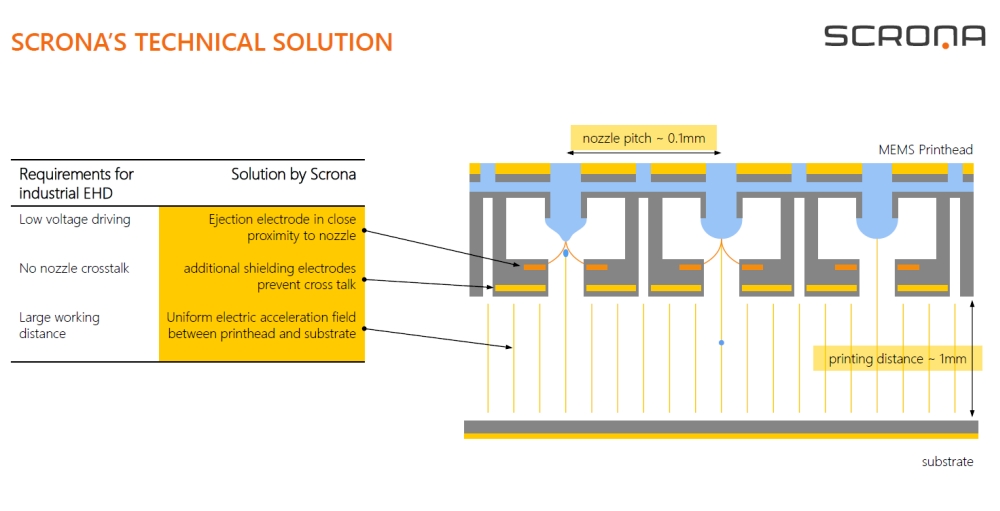 Slide from Scronas presentation at IPI 2025
Meanwhile, Quantica has demonstrated printhead architectures designed for particle-filled inks, including conductive materials and industrial coatings. Their NovoJet™ technology supports particle sizes up to 9 micrometres while maintaining controlled droplet formation.
Research presented by Fraunhofer IPA and the iPrint Institute highlighted how shear-thinning materials – which become less viscous under stress – combined with temperature-controlled printheads can help bridge the gap between analogue deposition methods and digital manufacturing workflows.
Together, these developments are extending inkjet beyond traditional graphic printing into the controlled deposition of functional industrial materials.
PRECISION AT SMALLER SCALES
Material compatibility alone is not enough. High-viscosity jetting also depends on extremely precise control of droplet formation and positioning.
At IPI 2025, several exhibitors demonstrated systems designed to improve registration accuracy on challenging substrates such as coated foils and battery electrodes. Ricoh presented inkjet systems that use real-time sensing to compensate for media movement and surface variation during printing.
EHD technologies are also pushing printing resolution toward the sub-micron range. Under controlled conditions, Scrona’s printheads can produce extremely fine conductive features suitable for microelectronics and semiconductor applications.
Another important area discussed at the conference was 3D structural electronics. Kelenn Technology demonstrated approaches for depositing conductive and dielectric materials directly onto three-dimensional components, potentially reducing assembly complexity in selected applications.
These developments illustrate how high-viscosity inkjet is becoming increasingly relevant not only for decoration or marking, but also for functional manufacturing.
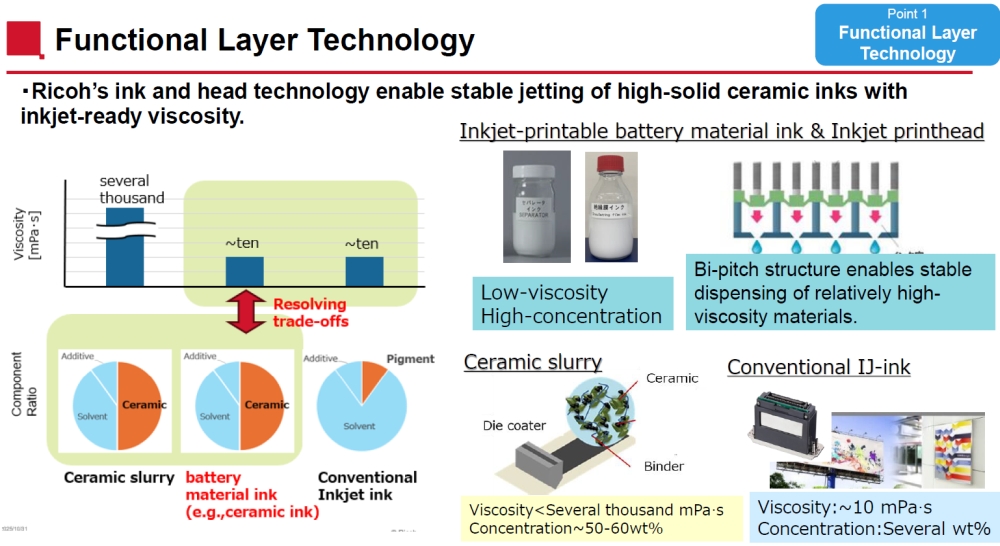 Slide from Ricohs presentation at IPI 2025
MOVING TOWARD INDUSTRIAL PRODUCTION
A recurring theme throughout the conference was the transition from research demonstration to industrial implementation.
Battery manufacturing attracted particular attention. Several speakers explored how digitally deposited functional layers could simplify aspects of battery production while reducing material waste. Ricoh presented work on directly printing insulating and separator layers onto electrodes as part of a more streamlined manufacturing workflow.
In packaging and industrial graphics, Nazdar Ink Technologies discussed high-viscosity water-based inks designed to deliver stronger colour density while reducing drying energy requirements.
High-resolution functional printing was another rapidly developing area. Hummink showcased its High Precision Capillary Printing technology for producing fine conductive structures, sensors, and waveguides at very small scales.
What became clear across these examples is that high-viscosity inkjet is increasingly being evaluated as a practical manufacturing tool rather than an experimental niche technology.
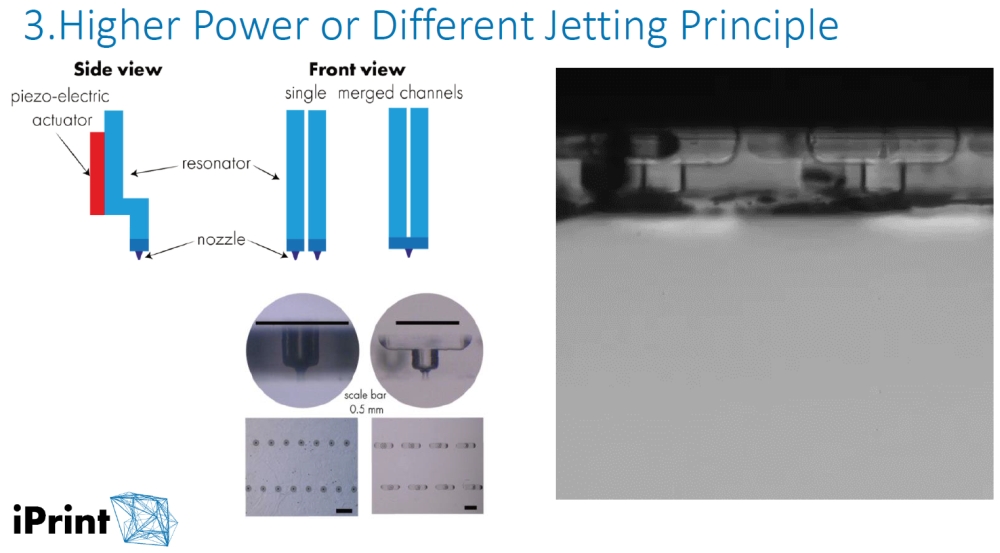 Slide from iPrints presentation at IPI 2025
ENGINEERING CHALLENGES REMAIN
Despite the momentum surrounding the technology, speakers at IPI 2025 also emphasised that significant engineering challenges remain.
Reliable jetting of highly viscous, particle-filled materials requires careful balancing of viscosity, particle size distribution, temperature, and chemical stability. Nozzle clogging, sedimentation, and long-term rheological stability remain important concerns, particularly in continuous industrial operation.
Polytype highlighted the role of advanced ink supply and circulation systems in maintaining stable pressure and temperature conditions during extended production runs.
Scalability was another major topic. Technologies demonstrated by Quantica and C-Marx showed how modular print engine architectures can increase throughput and print width while maintaining process stability.
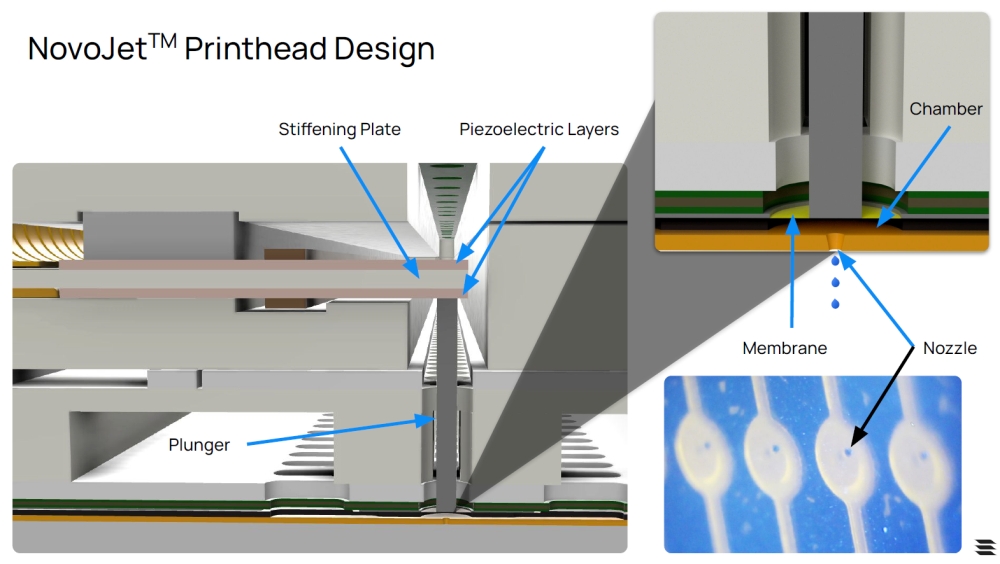 Slide from Quanticas presentation at IPI 2025
LOOKING AHEAD TO IPI 2026
IPI Conference 2025 demonstrated how quickly high-viscosity inkjet is evolving from a specialist research topic into a serious industrial manufacturing technology. Across presentations and technical discussions, the conference highlighted both the opportunities and the remaining engineering challenges facing the sector.
As development continues, areas such as advanced electronics, energy storage, packaging, additive manufacturing, and functional coatings are likely to remain key drivers of innovation.
The next edition of Industrial Print Integration Conference, taking place on 24-25 November 2026, will provide another opportunity to explore the latest developments in high-viscosity inkjet systems, printheads, materials, and industrial integration strategies. For companies working across industrial printing, electronics, materials science, and digital manufacturing, it is becoming an increasingly important area to watch.